
Screen Filter or Disc Filter? Matching the Filter to Your Water
Most drip failures start with a blocked emitter. Choosing the right first filter is the cheapest insurance a drip system has.
Why filtration decides whether the system works
Most drip irrigation failures come down to blocked emitters, and almost all of those begin with suspended solids in the source water. A filter is not an accessory bolted on at the end of the design — it is the component that decides whether the rest of the system performs at all.
The practical question is not which filter is better in general. It is what your water is carrying. Silt behaves differently from algae, and algae behaves differently from a heavy organic load, and each of those points at a different element.
What a screen filter does well
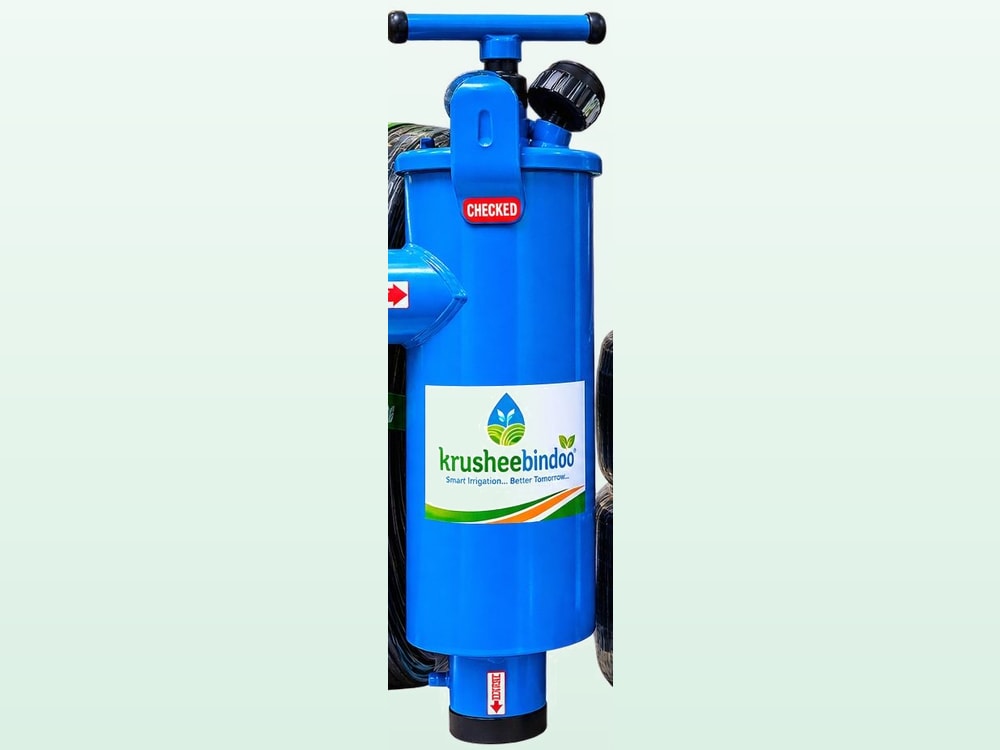
A screen filter passes water through a fine mesh that traps silt, algae and suspended organic matter before it reaches the laterals. Our 2 inch inline screen filter is rated at 120 mesh, roughly 125 micron, and handles up to 40 m³/h at a maximum working pressure of 10 bar.
It is the right first stage for relatively clean borewell or canal water, and it works well as a secondary stage behind a sand media filter. The clear bowl is the part that matters day to day: you can see the element and judge when it needs cleaning without breaking the line. The flanged top unscrews for fast element removal, and INLET and OUTLET are moulded into the body so the unit cannot be plumbed backwards in the field.
When to choose a disc filter instead
Where a screen blocks, a disc filter separates. Instead of a single mesh, a stack of thin grooved discs traps contaminants in the grooves between them. That gives a far larger filtration area and holds much more dirt before the pressure drop becomes noticeable — which is exactly what pond, canal and recycled water need.
Our 2 inch disc filter is rated at 130 micron with a maximum working pressure of 10 bar and up to 40 m³/h, and it is the usual second stage after a sand media filter. Because each disc can be removed, washed or replaced individually, there is no heavy cartridge to discard, and the whole stack separates with a single clamp for servicing between irrigation cycles.
Specifications at a glance
| Type | Inline screen (mesh) filter |
|---|---|
| Size (inlet/outlet) | 2" (50 mm) threaded |
| Mesh Rating | 120 mesh (approx. 125 micron) |
| Body | Blue glass-filled polymer |
| Element | Stainless steel / nylon mesh, removable |
| Max Working Pressure | 10 bar |
| Flow Rate | Up to 40 m³/h |
| Markings | Moulded INLET / OUTLET arrows |
See the product
Full specifications, minimum order quantity and pricing for this product.
Krusheebindoo Inline Screen Filter - 2" Blue
View productCommon questions
- Can I use a screen filter on pond water?
- You can, but it will need cleaning far more often. Pond and canal water carries algae and heavier organic load, which blinds a fine mesh quickly. A disc filter holds much more dirt before the pressure drop shows, so it is the better first stage there.
- Do I need more than one filter?
- Often yes. A sand media filter followed by a screen or disc filter is a common two-stage arrangement on dirty water, with the media filter taking the bulk of the load and the finer element catching what gets through. The right number of stages depends on the source, so it is worth describing your water when you ask for a recommendation.
- How do I know when a filter needs cleaning?
- The honest answer is a pressure differential, but the practical one is the bowl. On a screen filter the clear body lets you see how loaded the element is, which is why we keep it clear rather than opaque.
Related guides
- 12 mm vs 16 mm Drip Lateral: Which Diameter Should You Specify?
- Drip Irrigation Subsidy: How to Apply and Why Claims Get Rejected
- Drip Irrigation Cost per Acre: How to Work It Out